

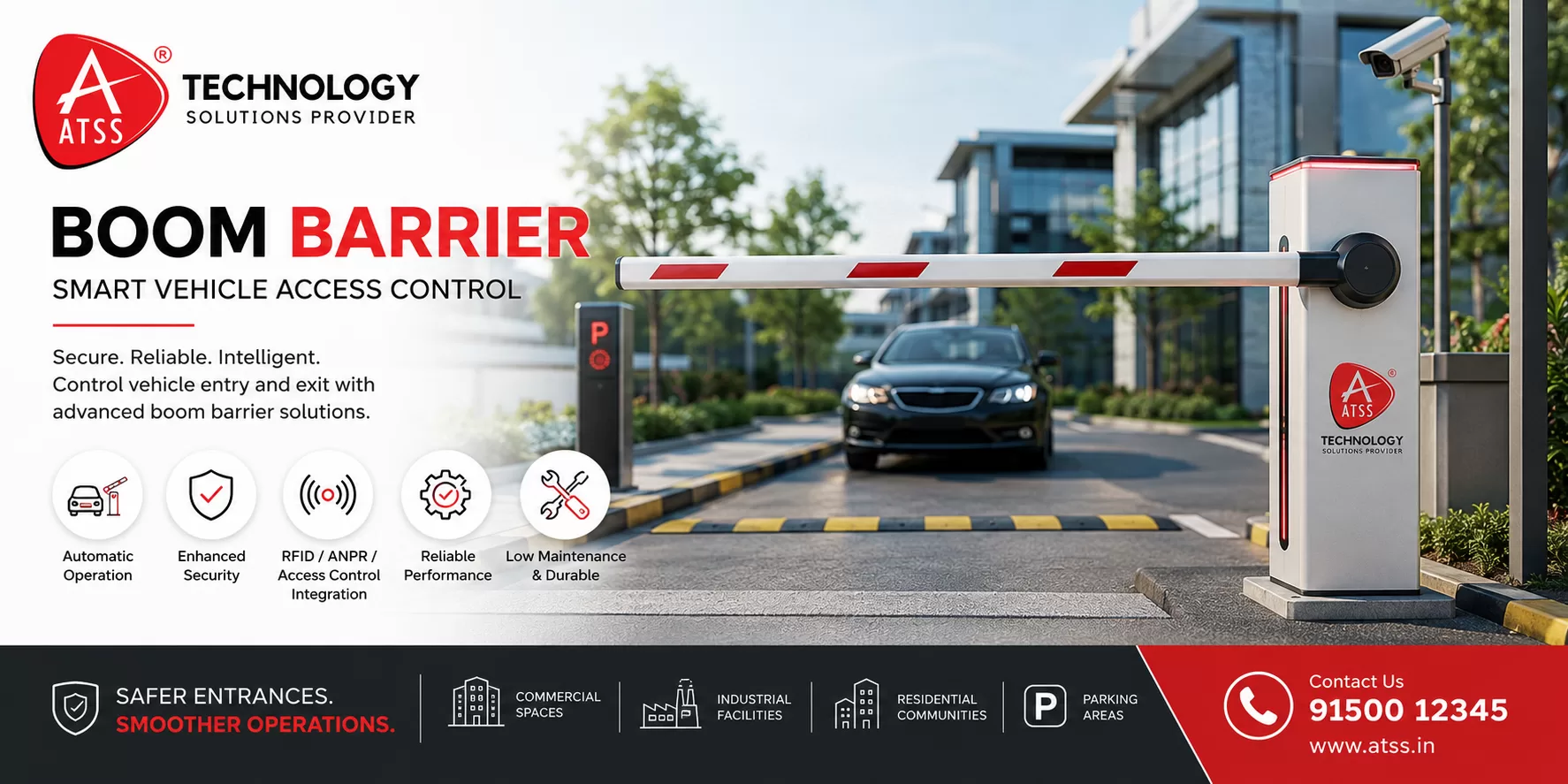
Boom Barrier: Complete Guide to Automatic Vehicle Access Control
Smart, Controlled and Efficient Vehicle Access for Modern Properties
A boom barrier is an automated vehicle-access system designed to control entry and exit at a defined point. Also called an automatic boom gate or barrier gate, it uses a horizontal barrier arm that raises and lowers to regulate vehicle movement.
Boom barriers are commonly used at:
- Apartments and gated communities
- Residential developments
- Corporate offices
- IT parks
- Factories
- Warehouses
- Industrial facilities
- Commercial buildings
- Parking facilities
- Hospitals
- Educational institutions
- Government and institutional premises
A boom barrier becomes more effective when it is integrated with suitable technologies such as RFID, ANPR, access control, CCTV and parking-management systems.
The right system, however, should not be selected simply by looking at the barrier or motor. The solution should be designed around the entrance, traffic volume, vehicle types, access requirements, safety considerations and operating environment.
What Is a Boom Barrier?
A boom barrier is an electromechanical vehicle-access control system that uses a horizontal arm to regulate vehicle movement through an entrance or exit.
When access is authorised, the barrier arm rises to allow the vehicle to pass. After the vehicle has cleared the controlled area, the arm can return to its closed position according to the configured operating sequence.
A typical vehicle-access process is:
Vehicle Approaches → Identification → Authorisation → Barrier Opens → Vehicle Passes → Barrier Closes
The barrier itself provides the physical access-control point. Additional technologies determine who or what is authorised to pass.
This distinction is important.
A boom barrier controls the physical movement of vehicles, while an access-control system determines whether access should be permitted.
How Does an Automatic Boom Barrier Work?
An automatic boom barrier combines mechanical movement, motorised operation and electronic control.
1. Vehicle Approaches
A vehicle arrives at the controlled entrance or exit.
2. Vehicle or User Is Identified
Depending on the installation, identification may use:
- RFID
- ANPR
- Access cards
- Remote controls
- Keypads
- Push buttons
- Other compatible access-control technologies
3. Access Is Authorised
The access-control system evaluates the received credential or identification information.
4. Barrier Opens
The control system sends the operating command to the barrier operator.
5. Vehicle Passes
The vehicle crosses the controlled lane.
6. Barrier Closes
The barrier returns to its closed position according to the configured operating and safety sequence.
For a complete system, the barrier, access-control technology, safety devices and vehicle-flow requirements should be considered together.
Main Components of a Boom Barrier System
A complete installation can contain several components.
Boom Arm
The horizontal arm physically controls vehicle passage.
Its length and configuration should correspond to the entrance and lane design.
Barrier Operator
The motorised mechanism raises and lowers the boom arm.
Control System
The controller receives operating commands and manages the barrier’s movement.
Access-Control Interface
The barrier can be connected to an appropriate access-control system.
Possible technologies include:
- RFID
- Access cards
- Remote controls
- ANPR
- Keypads
- Push buttons
- Integrated access-control software
Safety Devices
Appropriate detection and safety mechanisms can be incorporated based on the application and system design.
Manual Release
A suitable manual-release arrangement can provide an alternative operating method where required.
Visual Indicators
Some systems can incorporate lights or other indicators to improve visibility and communicate barrier status.
Types of Boom Barrier Systems
The appropriate barrier depends on the entrance configuration, traffic conditions and operating requirements.
Automatic Boom Barrier
An automatic boom barrier uses a motorised operator to raise and lower the barrier arm.
It is commonly considered for:
- Apartments
- Gated communities
- Offices
- Commercial properties
- Factories
- Parking areas
- Warehouses
- Institutional campuses
Manual Boom Barrier
A manual barrier requires an operator to raise and lower the arm.
It can be considered where vehicle traffic is limited and automatic operation is unnecessary.
Folding Boom Barrier
A folding configuration may be considered where vertical clearance creates a constraint for a conventional barrier arm.
Heavy-Duty Boom Barrier
Heavy-duty systems may be appropriate for demanding environments, subject to the manufacturer’s specifications, traffic conditions and installation requirements.
The correct configuration should always be determined from the actual site rather than from a generic product description.
Boom Barrier vs Automatic Gate
A boom barrier and an automatic gate both control vehicle access, but they solve different entrance requirements.
| Factor | Boom Barrier | Automatic Gate |
|---|---|---|
| Main function | Controls vehicle passage | Provides a physical gate closure |
| Movement | Rising horizontal arm | Sliding or swinging gate |
| Traffic flow | Well suited to controlled vehicle lanes | Depends on gate configuration |
| Physical obstruction | Barrier arm | Full gate |
| Space requirement | Generally compact | Depends on gate design |
| Common applications | Parking, communities, campuses and commercial entrances | Homes, properties, commercial and industrial entrances |
| Access integration | RFID, ANPR, access control and other systems | Remote control, access control and other automation |
Which one should you choose?
The answer depends on the property’s objective.
If the primary requirement is controlled vehicle flow through a defined lane, a boom barrier may be appropriate.
If the requirement is to secure and physically close the entire entrance, an automatic gate may be more appropriate.
Some properties may require both technologies at different access points.
Boom Barrier With RFID Access Control
RFID can be used to identify authorised vehicles or users.
A typical process is:
Vehicle Approaches → RFID Credential Detected → Credential Verified → Barrier Opens → Vehicle Passes
RFID-based vehicle access can be considered for:
- Apartment communities
- Gated communities
- Corporate campuses
- Employee parking
- Industrial facilities
- Private parking facilities
The advantage is that authorised users can experience controlled access without necessarily requiring manual intervention at every vehicle entry.
The complete system should be designed around the required reading distance, vehicle positioning, access-control software and entrance layout.
Boom Barrier With ANPR
ANPR, or Automatic Number Plate Recognition, uses camera-based technology to identify vehicle registration numbers.
A possible workflow is:
Vehicle Arrives → Number Plate Captured → Vehicle Identified → Access Decision → Barrier Operates
ANPR can be considered where vehicle identification and automated access decisions are important.
Potential applications include:
- Corporate campuses
- Parking facilities
- Industrial premises
- Commercial buildings
- Residential communities
- Controlled institutional entrances
ANPR should be considered as part of an integrated system involving the camera, software, access-control logic and barrier controller.
Boom Barrier With CCTV
A boom barrier can form part of a broader entrance-security system.
For example:
Boom Barrier + CCTV + Access Control + ANPR
can provide different layers of:
- Physical vehicle control
- Vehicle identification
- Visual verification
- Event monitoring
- Access management
CCTV can provide video visibility, while the barrier provides physical control and the access-control system manages authorisation.
The technologies therefore perform different but complementary functions.
Applications of Boom Barriers
Residential Communities
Boom barriers can help regulate resident and visitor vehicle movement at apartment and gated-community entrances.
Corporate Offices
They can be used to manage employee, visitor and authorised vehicle access.
IT Parks and Campuses
Large campuses may combine automatic barriers with RFID, ANPR, CCTV and access-control systems.
Industrial Facilities
Factories and warehouses may use controlled entrances for employees, contractors, deliveries and logistics vehicles.
Parking Facilities
Boom barriers are commonly used to control entry and exit at parking locations.
Educational Institutions
Schools, colleges and universities can use controlled vehicle entrances to manage authorised traffic.
Hospitals
Vehicle access can be structured for staff, visitors, service vehicles and other authorised users according to the site’s operating requirements.
Commercial Buildings
Shopping centres, office complexes and mixed-use developments can use barriers for vehicle and parking management.
Government and Institutional Premises
Boom barriers can form part of a broader vehicle-access and security architecture.
Benefits of Automatic Boom Barriers
Controlled Vehicle Access
A barrier creates a defined physical control point for vehicle movement.
Automated Operation
Motorised operation reduces the need for manual intervention at every vehicle movement.
Integration With Access Control
The barrier can work with appropriate technologies such as RFID, ANPR and access-control systems.
Improved Traffic Management
Controlled opening and closing can help organise vehicle movement through an entrance.
Security-System Integration
CCTV, ANPR and access control can be incorporated according to project requirements.
Operational Convenience
Authorised users can experience a smoother entry and exit process.
Scalable Solution
A barrier can form one component of a larger vehicle-access architecture that can evolve as requirements change.
How to Choose the Right Boom Barrier
The right barrier should be selected based on the application, not simply the product price.
1. Measure the Entrance Width
Determine the lane width that needs to be controlled.
The required boom-arm length should be selected according to the actual entrance configuration.
2. Understand Traffic Volume
Consider:
- Vehicles per hour
- Peak traffic periods
- Entry frequency
- Exit frequency
- Operating hours
- Residential or commercial usage
3. Identify Vehicle Types
Determine whether the entrance primarily handles:
- Cars
- SUVs
- Delivery vehicles
- Trucks
- Buses
- Mixed traffic
4. Determine the Access Method
Decide whether the system requires:
- RFID
- ANPR
- Remote control
- Access card
- Keypad
- Push button
- Integrated access control
5. Evaluate Safety Requirements
Vehicle and obstacle detection should be considered according to the entrance design and operating environment.
6. Evaluate the Installation Environment
Consider:
- Rain
- Dust
- Heat
- Corrosion
- Outdoor exposure
- Electrical conditions
- Available mounting space
7. Consider Power and Backup Requirements
The electrical infrastructure and operational requirements should be evaluated during system design.
8. Plan for Future Integration
If future requirements may include RFID, ANPR, CCTV, parking management or other access technologies, the system architecture should be planned accordingly.
Boom Barrier Site Assessment Checklist
Before selecting a system, assess these factors:
- Entrance width
- Lane configuration
- Traffic volume
- Peak traffic
- Vehicle types
- Operating frequency
- Mounting location
- Available space
- Power supply
- Access-control requirement
- RFID requirement
- ANPR requirement
- CCTV requirement
- Safety detection
- Emergency/manual operation
- Future expansion
This assessment helps move the decision from “Which barrier should I buy?” to the more important question:
“What vehicle-access solution does this entrance actually require?”
Boom Barrier Installation
Professional installation involves more than mounting the barrier cabinet.
Important considerations include:
- Foundation and mounting surface
- Barrier-arm clearance
- Lane alignment
- Electrical supply
- Earthing
- Cable routing
- Access-control integration
- Safety detection
- Vehicle approach path
- Barrier visibility
- Manual-release access
- System configuration
- Functional testing
Before handover, test the complete installation under realistic operating conditions.
Boom Barrier Maintenance
Regular maintenance helps support consistent operation and system reliability.
A maintenance programme can include:
Mechanical Inspection
Check mounting, movement and mechanical components.
Boom-Arm Inspection
Check alignment, condition and visibility.
Operator Inspection
Inspect the motorised operating mechanism according to the manufacturer’s recommendations.
Safety-System Testing
Verify relevant sensors and safety mechanisms.
Electrical Inspection
Check electrical connections and related components.
Access-Control Testing
Confirm that RFID, ANPR, access cards or other integrated technologies communicate correctly with the barrier.
Functional Testing
Verify opening, stopping and closing operations.
Common Boom Barrier Installation Mistakes
Choosing Only by Price
The lowest initial cost does not necessarily represent the most appropriate solution.
Ignoring Traffic Volume
A residential entrance and a high-traffic industrial facility have different operational requirements.
Selecting the Arm Without Measuring the Lane
The boom-arm length should match the actual entrance configuration.
Treating the Barrier as a Standalone Product
The barrier should be evaluated together with access control, safety and security requirements.
Ignoring Safety Integration
Appropriate safety mechanisms should be considered during system design.
Poor Installation Planning
Foundation, electrical supply, vehicle approach and barrier positioning can influence the overall installation.
No Maintenance Strategy
Electromechanical systems benefit from periodic inspection and maintenance.
Boom Barrier for Apartments and Gated Communities
For residential communities, the objective is not simply to raise and lower a barrier.
The complete system may involve:
Resident Identification → Access Authorisation → Barrier Operation → Vehicle Entry → Event Recording
RFID can provide convenient access for registered vehicles where appropriate.
Visitor access can be handled through a separate process depending on the community’s requirements.
The system should be designed to balance:
Security + Convenience + Traffic Flow + Resident Experience
Boom Barrier for Commercial and Industrial Properties
Commercial and industrial entrances may experience higher traffic volumes and a wider range of vehicle types.
The solution should therefore consider:
- Employee access
- Visitor access
- Contractor access
- Delivery vehicles
- Logistics vehicles
- Security procedures
- Operating hours
- CCTV coverage
- ANPR requirements
- RFID requirements
- Emergency access
- Traffic flow
For these applications, the boom barrier should be treated as part of an integrated vehicle-access system.
Boom Barrier vs Road Blocker
A boom barrier primarily controls vehicle movement using a rising barrier arm.
A road blocker is a different physical-security technology designed to provide a stronger physical vehicle barrier.
The two should not be treated as interchangeable.
The appropriate technology depends on:
- Security objectives
- Threat assessment
- Vehicle types
- Traffic requirements
- Required physical protection
- Site design
For higher-security applications, a professional assessment should determine the appropriate physical-security technology.
Why Professional Solution Design Matters
A boom barrier is an electromechanical access-control component.
Its effectiveness depends on more than the hardware itself.
A complete solution involves:
Site Assessment
↓
Traffic Analysis
↓
Entrance Design
↓
Barrier Selection
↓
Access-Control Design
↓
Safety Design
↓
Installation
↓
Integration
↓
Testing & Commissioning
↓
Maintenance & Support
This solution-oriented approach is particularly important for commercial, industrial, institutional and high-traffic applications.
ATSS Approach to Boom Barrier Solutions
ATSS positions boom barriers within its wider electronic-security and access-control solution portfolio.
The solution approach should begin with understanding:
Customer → Entrance → Vehicle Flow → Access Requirement → Security Objective → Technology → Implementation → Support
This means the barrier is selected as part of the solution rather than treated as an isolated product.
Depending on the project requirement, a vehicle entrance can incorporate technologies such as:
- Boom barriers
- RFID
- ANPR
- Access control
- CCTV
- Intercom
- Parking management
- Other compatible security technologies
ATSS also offers boom-barrier products such as PB1000 and PB2000 within its product portfolio.
For product-specific technical specifications, customers should refer to the applicable manufacturer’s documentation and the relevant ATSS product information.
Boom Barrier in Chennai
Boom barriers can be considered for vehicle entrances across Chennai, including:
- Apartments
- Gated communities
- Corporate offices
- IT parks
- Factories
- Warehouses
- Schools and colleges
- Hospitals
- Commercial buildings
- Parking facilities
- Institutional campuses
For a Chennai installation, the solution should consider the actual site conditions, traffic pattern, entrance layout, environmental exposure and access-control requirements.
Looking for a Boom Barrier in Chennai?
Instead of selecting a barrier only from a catalogue, start with the entrance.
Measure → Assess → Design → Select → Install → Integrate → Support
Boom Barrier Decision Matrix
| Application | Typical Requirement | Possible Integration |
|---|---|---|
| Apartment | Controlled resident access | RFID + CCTV |
| Gated Community | Resident and visitor management | RFID + Access Control |
| Corporate Campus | Employee and visitor access | RFID + ANPR + CCTV |
| Parking Facility | Controlled entry and exit | Access Control + Parking System |
| Factory | Employee and logistics access | RFID + ANPR + CCTV |
| Warehouse | Delivery and vehicle control | ANPR + CCTV |
| Institution | Controlled vehicle entry | Access Control + CCTV |
| Commercial Building | Vehicle and parking management | RFID + ANPR |
Always determine the final configuration based on the actual site conditions and operational requirements.
Frequently Asked Questions About Boom Barriers
What is a boom barrier?
A boom barrier is an automated vehicle-access system that uses a horizontal arm to control vehicle entry and exit at a defined point.
What is an automatic boom barrier?
An automatic boom barrier uses a motorised operator to raise and lower the barrier arm in response to an authorised operating command.
How does a boom barrier work?
A boom barrier receives a control command, raises the arm to permit vehicle passage and then lowers the arm according to its configured operating and safety sequence.
What is a boom gate?
A boom gate is another commonly used term for a boom barrier. It uses a rising arm to control vehicle movement through an entrance.
Can a boom barrier work with RFID?
Yes. You can integrate a compatible boom barrier with RFID-based vehicle access control to identify authorised vehicles or users.
Can a boom barrier work with ANPR?
Yes. A compatible system can integrate with Automatic Number Plate Recognition to identify vehicles and support automated access decisions.
Can a boom barrier be connected to CCTV?
Yes. A boom barrier can form part of an integrated entrance-security system that includes CCTV and other security technologies.
Where are boom barriers used?
Boom barriers provide controlled vehicle access at apartments, gated communities, offices, factories, warehouses, parking facilities, commercial buildings, institutions, and other managed vehicle entrances.
Are boom barriers suitable for apartments?
Yes. You can use boom barriers at apartment and gated-community entrances to manage resident, visitor, and other authorised vehicle access.
Are boom barriers suitable for factories?
Yes. Industrial facilities can use boom barriers to control employee, contractor, delivery and logistics vehicle movement.
How do I choose a boom barrier?
Consider entrance width, traffic volume, vehicle types, operating frequency, access-control requirements, safety requirements, environmental conditions and future integration needs.
Does a boom barrier require maintenance?
Yes. Moreover, conduct periodic inspections and maintain the mechanical, electrical, control, and safety components according to the manufacturer’s recommendations.
The Right Boom Barrier Starts With the Right Assessment
Do not select a boom barrier solely based on:
- Price
- Arm length
- Motor specification
- Brand name
The better approach is to understand:
The Entrance
→ The Vehicles → The Traffic → The Access Method → The Safety Requirements → The Security Objective → The Future Requirement
Only then should the appropriate vehicle-access system be selected.
Need a Boom Barrier for Your Property?
Tell ATSS About Your Entrance
Whether you are planning a new vehicle entrance or upgrading an existing one, ATSS can help evaluate the application and identify an appropriate vehicle-access configuration.
ATSS Can Help Assess
- Entrance configuration
- Traffic requirements
- Barrier selection
- RFID integration
- ANPR integration
- CCTV integration
- Access-control requirements
- Installation considerations
- Future expansion
Request a Boom Barrier Site Assessment
Boom Barriers | Automatic Boom Gate | ANPR Integration | Access Control |
ATSS – Technology Solutions Provider
Chennai, Tamil Nadu, India
Call: 91500 12345