

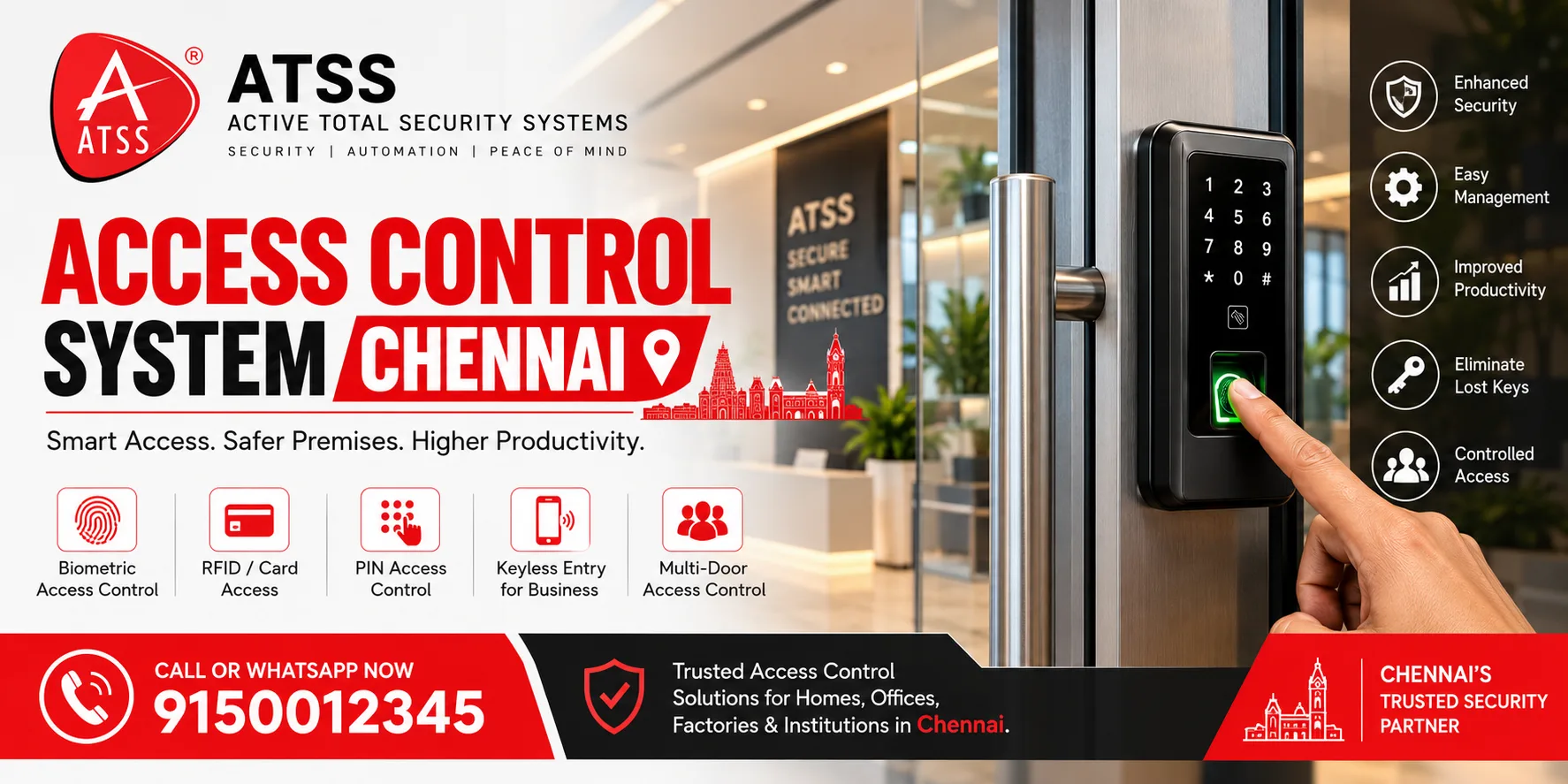
Access Control System Chennai
Access Control System Chennai: Complete Guide for Businesses
Need an access control system Chennai businesses can rely on? Compare biometric, RFID and multi-door solutions with expert guidance from ATSS. | WhatsApp
Introduction
Who can enter your office, factory or commercial building, and which areas can they access? If you still rely on physical keys or manual entry records, managing access can become difficult as your business grows. An access control system Chennai businesses can use helps control entry, manage user permissions and improve security across their premises.
From small offices in Anna Nagar to industrial facilities near Guindy and Sriperumbudur, the right system can make daily access management easier. However, choosing a suitable solution requires more than selecting a fingerprint reader or access card. You must also consider door hardware, user requirements, installation, emergency exits and future expansion.
This guide explains how access control works, which technologies are available, what affects pricing and how to select a reliable access control company in Chennai. It also explains how ATSS can help you evaluate your requirements.
What Is an Access Control System?
An access control system is an electronic security solution that controls who can enter a building, room or restricted area. It checks a user’s credentials against predefined permissions before allowing access.
For example, employees may enter the main office, while only authorised staff can access the server room. Similarly, a factory can restrict entry to selected production areas.
A typical system includes:
- Reader: Accepts or verifies a credential.
- Controller: Checks access permissions.
- Lock: Controls the door or entry point.
- Credentials: Fingerprints, RFID cards, PINs or supported mobile credentials.
- Software: Manages users, permissions and available access records.
- Power supply: Provides power to the relevant components.
Depending on the system, administrators can assign permissions by user, door, department or time schedule.
Why Do Chennai Businesses Need Access Control?
Chennai has a wide range of commercial offices, IT facilities, factories, educational institutions and residential communities. Each type of property has different access requirements. Therefore, a well-designed system should match the site’s actual needs.
1. Control access to restricted areas
Not every employee needs access to every room. An electronic system lets administrators assign permissions according to job roles and operational needs.
For example, a finance department may need access to a records room, while other employees can enter only common office areas.
2. Simplify employee access management
Physical keys can create problems when employees leave or change departments. However, an electronic credential can often be deactivated or updated without replacing the door lock.
This makes employee onboarding and offboarding easier.
3. Improve access accountability
Systems with event logging can record supported entry attempts and access decisions. As a result, authorised administrators can review activity when investigating an incident.
However, an access log does not always prove who physically entered. Shared or misused credentials can reduce accountability.
4. Manage multiple doors
A multi-door access control system can help businesses manage several entry points from a common interface, depending on the controller and software.
This can be useful for offices with different floors, departments or restricted areas.
5. Support a wider security strategy
Access control can work alongside CCTV, visitor management and security procedures. Together, these measures can improve visibility and control, although no single system eliminates every security risk.
Types of Access Control Systems
Different technologies suit different budgets, environments and security requirements.
RFID card access control
RFID access control allows users to present a compatible card or key fob to a reader.
Best suited for: Offices, apartment entrances, retail premises and facilities with many users.
Benefits: Convenient credential issuance and straightforward replacement of lost cards.
Considerations: Businesses must deactivate lost cards promptly and select appropriate credential security.
Biometric access control
Biometric systems verify a physical characteristic, such as a fingerprint, using a compatible reader.
Best suited for: Offices, restricted rooms and facilities that require identity-linked verification.
Benefits: Users do not need to carry a separate access card when the system relies on a biometric credential.
Considerations: Performance can vary with the device, environment and user conditions. Businesses must also protect biometric information and provide suitable alternatives where needed.
Face recognition access control
Face recognition terminals use facial image processing to verify credentials.
They may suit selected corporate entrances and environments where hands-free authentication is useful. However, businesses should assess performance, lighting conditions, privacy and data handling before deployment.
PIN-based access control
A PIN reader allows authorised users to enter a configured code. It can suit selected doors and restricted rooms.
Nevertheless, shared or predictable codes can weaken security. Individual credentials and regular code reviews may provide better accountability.
Mobile access control
Some systems support smartphone-based credentials. This can simplify credential management for compatible devices.
Before choosing this option, check device compatibility, licensing, connectivity requirements and alternatives for users without supported smartphones.
Essential Access Control System Features
When comparing access control products, evaluate the features that support your daily operations.
| Feature | Business benefit |
|---|---|
| User management | Makes it easier to add, update and remove users. |
| Door-wise permissions | Limits entry to authorised areas. |
| Time schedules | Applies access rules during selected periods. |
| Multi-door management | Supports centralised control where available. |
| Event logging | Records supported access activity. |
| Backup power | Helps maintain selected functions during outages. |
| Door monitoring | Can identify supported door alarms when compatible sensors are installed. |
| Integration | Connects compatible security and management systems. |
| Expansion capacity | Helps accommodate future requirements. |
| Maintenance support | Supports reliable long-term operation. |
Not every product supports every feature. Therefore, confirm the specifications of the actual reader, controller, software and locking hardware before purchasing.
How Does a Door Access Control System Work?
A typical door access control system follows six steps.
- A user presents a fingerprint, card, PIN or other supported credential.
- The reader verifies the credential.
- The controller checks the user’s permissions.
- The system grants or denies the access request.
- If authorised, the locking mechanism operates as configured.
- Where supported, the system records the event for later review.
The complete solution must include more than a reader. It also requires compatible door hardware, appropriate power supplies, safe exit arrangements and suitable configuration.
For example, an office may use an RFID reader at the entrance and a separate biometric reader for a restricted server room. This provides different levels of control for different areas.
Commercial Access Control Systems for Different Industries
Corporate offices
Businesses can restrict access to server rooms, records storage, finance departments and management areas. They can also simplify employee credential administration.
Factories and warehouses
Industrial facilities may need separate permissions for production areas, stores, administrative offices and equipment rooms. The system must also suit the environment and preserve safe movement.
Schools and colleges
Institutions can control access to administrative offices, laboratories and selected staff-only areas. Visitor management and emergency procedures should form part of the wider plan.
Hospitals and clinics
Healthcare facilities may require restricted access to records areas, pharmacies and equipment rooms. The design must account for authorised clinical access and emergency workflows.
Retail and residential properties
Retailers can control stockrooms and back-office areas. Apartment communities can manage selected entrances and common facilities, subject to appropriate visitor and emergency arrangements.
How to Choose an Access Control Company in Chennai
When comparing access control system dealers in Chennai, do not focus only on the equipment price. Instead, assess the provider’s ability to design, install and support the complete solution.
Use these criteria:
- Site assessment: Does the provider understand your doors, user groups and security requirements?
- System design: Does the proposal explain the readers, controllers, locks and software?
- Compatibility: Will the equipment work with your existing doors and infrastructure?
- Integration: Can the system connect to your required CCTV or attendance platform?
- Installation: Does the scope include configuration, testing and commissioning?
- Training: Will administrators learn how to manage permissions and credentials?
- Documentation: Will you receive operating instructions and relevant configuration records?
- Support: Are warranty and maintenance responsibilities clearly stated?
- Expansion: Can the solution accommodate additional doors or users?
Two quotations may list similar readers but include different controllers, locking hardware, software and installation work. Consequently, compare the complete scope rather than assuming that both proposals offer the same solution.
Access Control System Cost in Chennai
The cost of an access control system depends on the site’s requirements. A simple single-door installation differs significantly from a centrally managed system for several floors.
Key cost factors include:
- Number of doors and users
- RFID, fingerprint or face recognition technology
- Controller capacity
- Lock type and door compatibility
- Software and licensing
- Cabling and electrical work
- Network infrastructure and backup power
- Integration with other systems
- Installation, testing and training
- Warranty and ongoing support
How to prepare for a quotation
First, list every door that needs controlled entry. Next, identify the users, preferred credentials and permissions required for each door.
Then determine whether you need event reporting, attendance integration, CCTV integration or centralised management.
Finally, request a detailed bill of quantities that separates hardware, installation, software and other charges. This makes it easier to compare solutions fairly.
ATSS can help you explore suitable options through its Access Control Solutions page.
Access Control System in Chennai: Local Applications
The right configuration depends on the building, user groups and operating requirements. Different parts of Chennai and its surrounding industrial areas present different use cases.
Anna Nagar, T. Nagar and Adyar
Offices, professional establishments and commercial properties may need controlled entry to workspaces, records rooms and restricted departments.
Guindy and Guindy Industrial Estate
Industrial and commercial facilities may require access permissions for administrative offices, equipment rooms, stores and selected operational areas.
OMR, Perungudi and Sholinganallur
IT offices and business campuses may benefit from centralised user administration, multi-door management and restricted access to sensitive workspaces.
Velachery, Porur and Tambaram
Commercial premises, offices and residential communities may use access control for selected entrances, shared facilities and restricted rooms.
Ambattur Industrial Estate
Factories and warehouses may need different permissions for production, storage, administration and maintenance areas.
Pallavaram and Sriperumbudur
Industrial, logistics and commercial facilities may need to manage employee, contractor and visitor access across different entry points.
These are illustrative applications, not claims that every property in these locations requires access control or that every provider serves every area. Confirm service coverage and conduct a site assessment before selecting a solution.
Integrating Access Control With CCTV and Attendance
Access control can provide greater operational value when it works with compatible security systems.
CCTV integration: Depending on the equipment, administrators may be able to review video associated with selected access events.
Time attendance integration: Compatible systems may connect access events with employee attendance workflows. However, a door entry record does not automatically prove actual working hours.
Visitor management: Supported platforms may help manage visitor registration, authorisation and temporary credentials.
Smart locks and video door phones: Compatible devices can support selected residential and commercial applications.
Fire and building systems: Integration requires careful design. Emergency egress and safe operation must remain priorities, and compatibility should be verified before installation.
Maintenance, Privacy and Security Best Practices
After installation, regular checks help maintain reliable operation.
- Review user permissions and remove obsolete credentials.
- Test readers, locks and compatible door sensors.
- Check backup power and recovery procedures.
- Review administrator accounts and access logs.
- Apply appropriate software and firmware updates.
- Protect management interfaces and network connections.
- Keep configuration and maintenance records.
- Test emergency exit arrangements according to the system design.
- Establish suitable data retention and privacy practices.
For biometric systems, assess how the organisation collects, stores, protects and deletes biometric information. Also provide an appropriate alternative for users who cannot reliably authenticate.
Frequently Asked Questions
1. Which access control system is suitable for an office in Chennai?
The choice depends on the number of doors, users, restricted areas and preferred credentials. A small office may need a simple reader, while a multi-floor business may require centralised management. Assess the existing infrastructure, backup power, integration needs and future expansion before selecting a system.
2. Can an access control system manage multiple doors?
Yes. Compatible multi-door systems can manage several entry points through supported controllers and software. Check door capacity, licensing, centralised administration and expansion options before purchasing.
3. Is fingerprint access control better than RFID?
Neither technology is universally better. RFID can simplify card management, while fingerprint verification can provide identity-linked authentication. Evaluate convenience, security, privacy, environment and total cost before deciding.
4. Can access control integrate with CCTV?
Compatible systems may associate access events with relevant video footage. Verify platform compatibility, licensing, timestamp synchronisation and recording requirements before deployment.
5. How do I obtain an access control quotation in Chennai?
Prepare the door count, approximate user count, preferred credential types, integration requirements and project location. Contact ATSS to discuss the scope and determine whether a site assessment is required.
Conclusion
Choosing an access control system Chennai businesses can rely on requires careful planning. The right solution should match the number of doors, user permissions, security requirements, existing infrastructure and future expansion plans.
RFID, fingerprint, face recognition and multi-door systems offer different benefits. However, reliable results depend on correct system design, compatible hardware, professional installation, safe operation and ongoing maintenance.
When comparing access control system dealers in Chennai, evaluate the complete solution rather than just the equipment price. A well-planned installation can make access management easier while supporting a wider security strategy.
Planning an access control installation or upgrade? Contact ATSS to discuss your requirements and explore a suitable solution.
Call or WhatsApp: 9150012345 | Website: https://www.atss.in/access-control | Company: Active Total Security Systems (ATSS)