

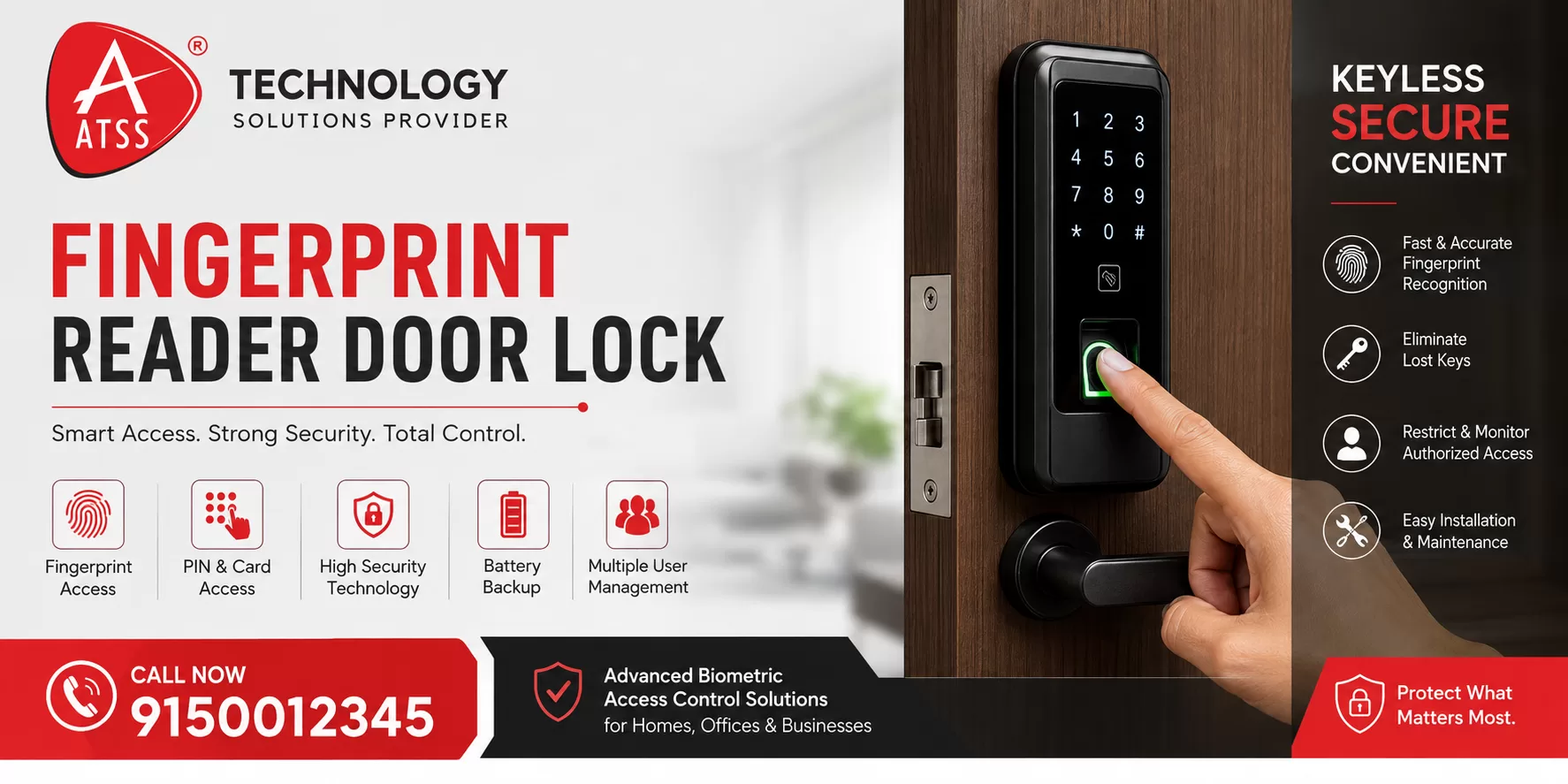
Fingerprint Reader Door Lock
Fingerprint Reader Door Lock in Chennai
Biometric Door Access Solutions for Homes, Offices and Controlled-Access Areas
A Fingerprint Reader Door Lock combines biometric authentication with electronic door locking to provide controlled access without depending solely on conventional keys. By registering authorised fingerprints, users can authenticate themselves at the door and gain access according to the capabilities of the selected lock.
ATSS provides fingerprint door lock and biometric access-control solutions in Chennai for residential, commercial and institutional applications. The appropriate solution depends on the door type, number of users, access requirements, operating environment and the level of access management required.
Need help selecting the right fingerprint door lock?
Share your door type, application and approximate number of users with ATSS for a solution-oriented recommendation.
Discuss Your Fingerprint Door Lock Requirement – WhatsApp Us
What Is a Fingerprint Reader Door Lock?
A fingerprint reader door lock integrates a biometric fingerprint reader with an electronic locking mechanism.
Instead of relying only on a physical key, the system can authenticate an authorised user through a registered fingerprint. Depending on the product, additional authentication methods such as PIN, RFID card or mechanical key may also be available.
This makes fingerprint door locks useful for applications where organisations or property owners want convenient access combined with controlled user authentication.
How the Technology Creates Business Value
The technology itself is only one part of the solution.
A properly selected fingerprint door lock can help address three practical requirements:
Convenience
Users can authenticate without carrying a conventional key.
Access Control
Access can be restricted to registered users supported by the selected system.
Operational Simplicity
Biometric authentication can reduce the dependency on distributing and managing physical keys for everyday access.
The right solution, however, should always be selected according to the actual application rather than technology alone.
Why Choose a Fingerprint Door Lock?
1. Biometric Authentication
Users authenticate using registered fingerprints. This provides an individual authentication method instead of relying exclusively on a shared physical key.
2. Reduced Key Dependency
For suitable applications, fingerprint authentication can reduce the need to issue and manage physical keys for regular users.
3. Multiple Authentication Options
Depending on the model, users may have access through fingerprint, PIN, RFID card, mechanical key or other supported credentials.
4. User-Based Access
The system can associate authentication credentials with registered users, subject to the capabilities of the selected device.
5. Convenient Everyday Access
Users can authenticate directly at the door, making biometric access practical for frequently used entry points.
6. Suitable for Selected Controlled Areas
Fingerprint locks can provide door-level access control for offices, cabins, restricted rooms and other areas where controlled entry is required.
Fingerprint Reader Door Lock Applications
A fingerprint door lock can support a wide range of applications.
Residential Applications
- Main entrance doors
- Apartments
- Individual homes
- Private rooms
- Home offices
- Storage areas
Commercial Applications
- Corporate offices
- Manager cabins
- Meeting rooms
- Restricted departments
- Server rooms
- Records rooms
- Stores
- Equipment rooms
Institutional Applications
- Administrative areas
- Staff-only rooms
- Laboratories
- Restricted facilities
- Equipment areas
- Controlled-access rooms
The final configuration should match the site’s physical and operational requirements.
Fingerprint Door Lock for Home
A fingerprint door lock for home can provide convenient biometric access for authorised residents.
Instead of depending entirely on physical keys, suitable models allow registered users to authenticate at the door using their fingerprints.
Before installation, consider:
- Door construction
- Door thickness
- Existing lock arrangement
- Number of users
- Required authentication methods
- Power requirements
- Emergency access arrangements
- Indoor or outdoor installation conditions
The product should be selected only after confirming compatibility with the actual door.
Fingerprint Door Lock for Office
Businesses can use fingerprint door locks to control access to selected areas within an office.
Typical applications include:
- Director cabins
- Manager cabins
- Server rooms
- Stores
- Records rooms
- Restricted departments
- Staff-only areas
- Equipment rooms
For a single door or small user group, a standalone biometric lock may be appropriate.
For multiple doors, larger user groups or centralised administration, a networked access control system may provide a more suitable architecture.
Standalone Fingerprint Lock vs Networked Access Control
Choosing between a standalone fingerprint lock and a networked access-control solution is an important design decision.
| Requirement | Standalone Fingerprint Lock | Networked Access Control |
|---|---|---|
| Single-door application | Suitable | Suitable |
| Multiple doors | Limited depending on system | More suitable |
| Centralised user management | Limited | Available depending on system |
| Multiple access points | Limited | Suitable |
| Central administration | Product dependent | Designed for central management |
| Larger organisations | May be limited | Generally more appropriate |
| Expansion | Product dependent | Better suited to scalable deployments |
The objective should not be to select the most sophisticated technology. The objective should be to select the right architecture for the actual requirement.
How Does a Fingerprint Reader Door Lock Work?
The typical process involves the following stages:
Step 1: User Registration
Authorised users are enrolled in the biometric lock or associated access-control system.
Step 2: Fingerprint Authentication
The user places a registered finger on the fingerprint reader.
Step 3: Credential Verification
The device evaluates the presented fingerprint against the enrolled credentials according to its authentication technology.
Step 4: Access Decision
If authentication is accepted, the locking mechanism permits access.
Step 5: Door Entry
The authorised user enters through the controlled door.
The exact workflow varies according to the manufacturer, product model and system architecture.
How to Select the Right Fingerprint Door Lock
Selecting a biometric lock should begin with the application, not the product catalogue.
Door Compatibility
Confirm:
- Door material
- Door thickness
- Door opening direction
- Lock dimensions
- Existing hardware
- Required locking mechanism
User Capacity
Determine the approximate number of users and select a device with adequate fingerprint and credential capacity.
Authentication Requirements
Decide whether the application requires:
- Fingerprint
- PIN
- RFID card
- Mechanical key
- Multiple authentication methods
Environment
Consider whether the lock will operate indoors or in an environment exposed to different operating conditions.
Power Requirements
Review the manufacturer’s requirements for power supply, battery operation and emergency access.
Access Management
For larger installations, determine whether the organisation requires:
- Centralised administration
- Multiple doors
- User management
- Access records
- Integration with other security systems
Future Expansion
If additional doors may be added later, consider a system architecture that can accommodate future requirements.
Fingerprint Door Lock Installation in Chennai
Professional installation helps ensure that the selected lock works correctly with the actual door and site conditions.
The installation process may involve:
- Site assessment
- Door and hardware verification
- Product compatibility confirmation
- Lock installation
- Fingerprint reader installation
- Power and wiring configuration where applicable
- User enrolment
- Functional testing
- Customer orientation
- Handover
The final installation method depends on the product and door configuration.
Why Site Assessment Matters
A common mistake is selecting a fingerprint lock based only on photographs, specifications or price.
A professional assessment considers the complete application.
The assessment should consider:
Door
Is the selected locking mechanism compatible?
Users
How many people require access?
Security
Which areas require controlled entry?
Operations
How frequently will the door be used?
Infrastructure
Is suitable power and networking available where required?
Future Requirements
Could the customer need additional doors or centralised access management?
This approach helps avoid selecting a product that is technically attractive but unsuitable for the actual site.
Fingerprint Door Lock vs Traditional Key Lock
Both technologies can serve legitimate applications.
| Parameter | Traditional Key Lock | Fingerprint Door Lock |
|---|---|---|
| Primary credential | Physical key | Fingerprint |
| User authentication | Key possession | Biometric credential |
| Key distribution | Required | Reduced for biometric users |
| User registration | Generally unavailable | Supported by suitable systems |
| Access method | Key | Fingerprint and potentially other credentials |
| Electronic functionality | Generally limited | Available depending on model |
| Application | Basic locking | Controlled biometric access |
The correct choice depends on the required level of access control and operational convenience.
Fingerprint Door Lock vs Biometric Access Control System
These terms are related but should not always be treated as interchangeable.
A fingerprint door lock generally refers to a door-level locking solution with an integrated fingerprint authentication mechanism.
A biometric access-control system can include separate readers, controllers, software and multiple access points.
Choose a fingerprint door lock when:
- You need access control for an individual door.
- The user group is relatively limited.
- Integrated door-level authentication is appropriate.
- Centralised multi-door management is not essential.
Consider a broader access-control system when:
- Multiple doors require management.
- The organisation has a larger user base.
- Centralised administration is required.
- Access records are important.
- The system may need to expand.
- Integration with other security technologies is required.
Common Fingerprint Door Lock Selection Mistakes
Choosing Based Only on Price
The lowest-cost product may not provide the required functionality, compatibility or long-term suitability.
Ignoring Door Compatibility
A biometric lock must physically and mechanically suit the door.
Underestimating User Capacity
The selected device should accommodate the required number of users and credentials.
Ignoring Future Expansion
A solution suitable for one door today may not meet tomorrow’s requirements.
Selecting Technology Before Defining the Requirement
The application should determine the technology, not the other way around.
Treating All Fingerprint Locks as Equivalent
Fingerprint locks differ in authentication methods, capacity, construction, management features, integration capabilities and installation requirements.
What Information Should You Provide Before Requesting a Fingerprint Door Lock?
To receive a more relevant recommendation, provide:
- Application: home, office, institution or commercial premises
- Number of doors
- Approximate number of users
- Door material
- Door type
- Indoor or outdoor location
- Required authentication methods
- Standalone or networked requirement
- Existing access-control infrastructure
- Any specific integration requirements
This information allows the solution provider to evaluate the requirement more accurately.
Why Choose ATSS?
ATSS follows a solution-oriented approach to electronic security.
The objective is not simply to supply a fingerprint lock. The objective is to understand the customer’s requirement, identify the appropriate technology, implement the solution correctly and support the solution through its lifecycle.
ATSS Solution Approach
Understand
Identify the customer’s access-control requirement.
Assess
Evaluate the door, users, environment and operational conditions.
Recommend
Select an appropriate fingerprint lock or biometric access-control architecture.
Implement
Install and configure the selected solution according to site requirements.
Test
Verify authentication and door operation before handover.
Support
Provide appropriate post-installation support based on the solution.
Fingerprint Reader Door Lock in Chennai
If you are looking for a fingerprint reader door lock in Chennai, start by defining the application and door requirements before selecting a product.
ATSS can help evaluate requirements for residential, commercial and institutional applications and identify an appropriate biometric door-access solution.
Whether you need a fingerprint lock for a single office door or a broader biometric access-control solution, the selection should consider the complete operating environment rather than one feature or specification.
Looking for a fingerprint door lock in Chennai?
Discuss your door type, application and user requirement with ATSS to identify a suitable solution.
Frequently Asked Questions
What is a fingerprint reader door lock?
A fingerprint reader door lock combines a fingerprint biometric reader with a door locking mechanism to authenticate authorised users and control access.
Is a fingerprint door lock suitable for homes?
Yes. Suitable models can be used for residential doors when the product matches the door construction, locking arrangement and required access method.
Can fingerprint door locks be used in offices?
Yes. They can be used for cabins, server rooms, stores, restricted departments and other controlled-access areas.
Can a fingerprint door lock support PIN or RFID cards?
Some models support additional credentials such as PIN, RFID card or mechanical key. The available features depend on the specific product.
How many users can a fingerprint door lock support?
User and fingerprint capacity varies by model. Select a device according to the number of authorised users and the required credential capacity.
Can fingerprint door locks be connected to an access-control system?
Some products can operate as part of a broader access-control architecture. Compatibility depends on the product and system configuration.
Can a fingerprint lock be installed on an existing door?
Potentially, but compatibility must be verified. Door dimensions, construction, locking arrangement and hardware configuration can affect installation.
Is professional installation required?
Professional installation is recommended when the solution involves electronic locking, wiring, configuration or integration with other access-control equipment.
What is better: fingerprint lock or access-control system?
Neither is universally better. A fingerprint lock may suit an individual door, while a networked access-control system may be more appropriate for multiple doors, larger user groups and centralised administration.
What should I consider before buying a fingerprint door lock?
Consider door compatibility, user capacity, authentication methods, environment, power requirements, access management, integration requirements and future expansion.
Final Takeaway
A Fingerprint Reader Door Lock can provide convenient biometric authentication for residential, commercial and institutional applications.
However, successful deployment depends on more than the fingerprint reader itself.
The right solution should match:
Door + Users + Application + Authentication + Environment + Access Management + Future Requirements
ATSS can help assess these factors and recommend an appropriate fingerprint door lock or biometric access-control solution in Chennai.
Related ATSS Solutions
Access Control System | Biometric Access Control | Fingerprint Access Control | Smart Lock | RFID Door Lock | Door Access Controller | Time Attendance System | Electronic Security Systems | Security System Installation