

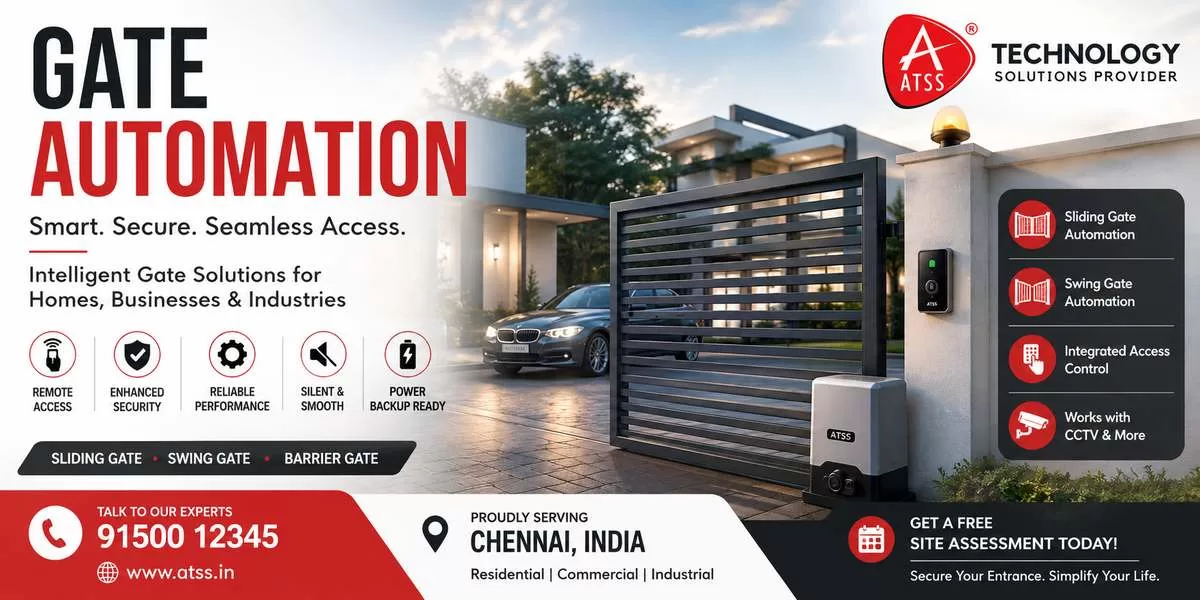
Gate Automation: Complete Guide to Automatic Gate Systems
Gate Automation in Chennai for residential, commercial and industrial properties. Discover sliding and swing gate systems designed for secure, convenient access.
Smarter Vehicle Access for Homes, Communities, Commercial and Industrial Properties
A gate is more than an entrance. It is the first controlled point between your property and the outside world.
Gate automation uses motorised technology to open and close a vehicle gate with controlled operation, reducing the need for manual handling and creating a more convenient approach to vehicle access.
Modern automatic gate systems can be designed for residential properties, villas, gated communities, offices, commercial buildings, factories, warehouses, institutions and other premises where controlled vehicle movement is required.
But choosing gate automation is not simply a matter of buying a motor.
The correct solution depends on the gate type, dimensions, weight, mechanical condition, operating frequency, available space, safety requirements, access-control requirements and site conditions.
This guide explains how gate automation works, the major types available, how to select the right system and how automation can be integrated with a broader security solution.
What Is Automatic gate Gate Automation?
Gate automation is the use of an electrically powered motor and control system to automate the opening and closing of a vehicle gate.
Instead of manually pushing or pulling the gate, an authorised user can initiate the opening cycle using an appropriate control method.
Depending on the system, operation may involve:
- Remote control
- Access-control devices
- RFID
- Keypad
- Smartphone-based control
- Intercom or video door phone integration
- Other compatible automation interfaces
A typical automatic gate solution consists of several elements working together:
Gate → Motor/Operator → Control System → Safety Devices → Access Method → Controlled Entry/Exit
ATSS identifies gate automation as part of its wider automation portfolio, with sliding gate and swing gate solutions forming the principal categories.
Why Automatic Gate Matters
Traditional manual gates can require the driver or security personnel to physically open and close the entrance.
This can become inconvenient when:
- It is raining
- It is dark
- Vehicles arrive frequently
- The gate is large or heavy
- Security personnel must repeatedly operate the entrance
- The property requires controlled vehicle access
- The entrance needs integration with other security technologies
Gate automation addresses the operational problem by mechanising the gate movement.
The objective is not merely automation for its own sake.
The real objective is to create a more convenient, controlled and appropriately engineered vehicle entrance.
Main Types of Gate Automation
There are two primary gate configurations to consider.
1. Sliding Gate Automation
A sliding gate moves horizontally along a suitable track or guide system.
A motorised sliding gate system generally uses a motor and gear mechanism to move the gate along its travel path. ATSS describes sliding gate motors as systems in which a rack and pinion arrangement transfers motor movement to the sliding gate.
Sliding Gate Automation Is Suitable For
- Independent houses
- Villas
- Apartment communities
- Commercial properties
- Office premises
- Factories
- Warehouses
- Industrial entrances
- Institutional campuses
Key Considerations
Before selecting a sliding gate motor, evaluate:
- Gate weight
- Gate length
- Track condition
- Gate alignment
- Frequency of operation
- Available side clearance
- Power availability
- Required access-control integration
A motor should be selected according to the actual application rather than simply choosing a model based on price.
Explore: Sliding Gate Electric Motor
2. Swing Gate Automation
A swing gate operates around hinges, opening in an arc similar to a conventional door.
Swing gate automation uses a motorised operator to control the movement of one or more gate leaves.
ATSS’s swing-gate information identifies applications across residential, commercial and industrial environments and describes above-ground and underground automation approaches.
Swing Gate Automation Is Suitable For
- Houses
- Villas
- Residential entrances
- Gated communities
- Offices
- Commercial premises
- Institutional properties
- Industrial entrances
Key Considerations
The automation design should consider:
- Gate leaf dimensions
- Gate weight
- Hinge condition
- Opening angle
- Available clearance
- Wind exposure
- Operating frequency
- Motor mounting requirements
- Safety requirements
Explore: Swing Gate Automation
Sliding Gate vs Swing Gate Automation
| Factor | Sliding Gate | Swing Gate |
|---|---|---|
| Movement | Horizontal | Hinged/arc movement |
| Main requirement | Suitable sliding path | Suitable hinge and swing clearance |
| Space requirement | Side clearance | Front/back opening clearance |
| Common application | Large entrances and driveways | Residential and architectural entrances |
| Mechanical assessment | Track, rollers and alignment | Hinges, leaves and clearance |
| Automation choice | Sliding gate operator | Swing gate operator |
The correct choice should be based on the existing or planned gate design and site conditions, not simply on which technology appears more attractive.
How Does an Automatic Gate System Work?
The operating sequence is straightforward:
Step 1: Authorised User Initiates Access
A suitable control device sends an operating command.
Step 2: Control System Processes the Command
The gate controller activates the appropriate operating sequence.
Step 3: Motor Moves the Gate
The gate operator generates the mechanical movement required to open the gate.
Step 4: Safety System Monitors Operation
Where applicable, safety devices can be incorporated into the installation to support safer gate movement.
Step 5: Vehicle Passes
The entrance remains available for the required access cycle.
Step 6: Gate Closes
The system completes the closing operation according to its configured operating sequence.
The exact architecture depends on the selected automation system and project requirements.
What Are the Benefits of Motorised Gate ?
1. Convenience
Drivers can operate the gate without manually opening and closing it.
This can be particularly useful during rain, at night or when vehicle access is frequent.
2. Controlled Vehicle Access
Gate automation can be integrated with appropriate access-control technologies to help manage vehicle entry and exit.
3. Reduced Manual Operation
Automation reduces repetitive manual gate operation for occupants, security personnel or facility staff.
4. Integration With Security Systems
Depending on the project, gate automation can form part of a larger entrance-security ecosystem involving CCTV, access control, RFID, intercom, ANPR and related technologies.
ATSS presents gate automation alongside broader electronic-security and entrance-automation solutions.
5. Better Entrance Experience
A correctly engineered automatic gate can make vehicle arrival and departure smoother and more convenient.
6. Application Flexibility
Gate automation can be designed for residential, commercial, institutional and industrial environments, subject to the gate and operating requirements.
Gate Automation Is Not the Same as Access Control
These two concepts are often confused.
Gate Automation
Controls the movement of the physical gate.
Access Control
Controls who or what is authorised to enter or exit.
They can operate independently or be integrated.
For example:
Vehicle Arrives → User Identification → Authorisation → Gate Opens → Vehicle Enters → Gate Closes
This distinction is important when planning a complete vehicle-access solution.
A property may require only a remote-controlled gate, while another site may need a more integrated solution involving RFID, CCTV, ANPR, intercom or other access technologies.
Gate Automation and CCTV Integration
Gate automation can form part of a broader entrance-security architecture.
For example:
CCTV + Automatic Gate Systems + Access Control + Intercom
can provide different layers of visibility, identification, communication and physical access management.
For larger premises, the system may be expanded further depending on operational requirements.
The important principle is:
Design the entrance as a system, not as an isolated motor installation.
Can Gate Automation Be Added to an Existing Gate?
In many applications, an existing gate may be suitable for automation.
However, automation should not be assumed to be compatible simply because the gate physically opens and closes.
A professional assessment should examine:
- Gate construction
- Gate weight
- Gate dimensions
- Alignment
- Hinges
- Rollers
- Track condition
- Structural integrity
- Available operating clearance
- Electrical supply
- Frequency of operation
For example, a sliding gate with poor alignment or mechanical resistance may require corrective work before automation is installed.
Similarly, a swing gate with unsuitable hinges or excessive resistance may not deliver the expected performance from a motor alone.
The automation system should be designed around the gate—not the other way around.
How to Choose the Right Gate Automation System
Before selecting a gate motor, answer these questions.
1. What Type of Gate Do You Have?
Is it:
- Sliding?
- Single swing?
- Double swing?
- Another specialised configuration?
2. How Large and Heavy Is the Gate?
Gate dimensions and weight influence the appropriate automation solution.
3. How Frequently Will the Gate Operate?
A residential entrance with limited daily operation has different requirements from a factory or commercial entrance with frequent vehicle movement.
4. Is the Gate Mechanically Healthy?
Check:
- Alignment
- Hinges
- Rollers
- Tracks
- Structural condition
- Manual movement
5. How Much Space Is Available?
Sliding and swing gates require different spatial conditions.
6. How Will Users Operate the Gate?
Possible control methods depend on the chosen system and may include:
- Remote control
- RFID
- Keypad
- Smartphone
- Access-control integration
- Intercom
7. Does the Gate Need Security Integration?
Consider whether the gate should work with:
- CCTV
- Access control
- RFID
- ANPR
- Intercom
- Video door phone
- Home automation
8. What Happens During Power Failure?
The solution should include an appropriate operational strategy for the property’s requirements, including suitable manual-release or backup arrangements where applicable.
Gate Automation for Different Applications
Residential Gate Automation
For homes and villas, the priorities are generally convenience, controlled access, ease of operation and integration with other residential security technologies.
Apartment and Gated Community Gate Automation
Community entrances may have substantially higher vehicle movement.
The solution should therefore be considered alongside access control, visitor management and traffic-flow requirements.
Commercial Gate Automation
Offices, commercial buildings and business premises may require controlled access combined with CCTV and other security technologies.
Industrial Gate Automation
Factories, warehouses and industrial facilities can have larger gates and higher operating frequency.
Gate selection and automation therefore require greater attention to mechanical and operational requirements.
Institutional Gate Automation
Schools, colleges, hospitals and other institutions may require controlled vehicle movement while maintaining convenient access for authorised users.
Common Gate Automation Mistakes
Mistake 1: Choosing Only by Motor Price
The lowest initial price does not necessarily represent the most appropriate solution.
The total solution includes equipment, mechanical suitability, installation, configuration, safety considerations and support.
Mistake 2: Ignoring Gate Mechanics
A motor cannot compensate indefinitely for a gate with poor alignment, damaged rollers, unsuitable hinges or excessive mechanical resistance.
Mistake 3: Selecting the Motor Before Assessing the Gate
The gate should be assessed before final equipment selection.
Mistake 4: Treating Automation as a Standalone Product
The gate may need to interact with access control, CCTV or other entrance technologies.
Mistake 5: Ignoring Usage Frequency
A gate used several times per day is fundamentally different from a high-traffic entrance.
Mistake 6: Focusing Only on Installation
A professional solution should consider commissioning, user training, troubleshooting, maintenance and future requirements.
Gate Automation: Product vs Solution
This is one of the most important distinctions for a customer.
A gate motor is a product.
A gate automation system is a solution.
The solution includes:
Site Assessment
↓
Gate Evaluation
↓
Requirement Analysis
↓
Automation Selection
↓
Access & Safety Design
↓
Installation
↓
Testing & Commissioning
↓
User Handover
↓
Service & Support
This solution-oriented approach helps ensure that the technology is matched to the actual application.
Why Professional Gate Automation Design Matters
A successful automatic gate installation depends on more than the motor itself.
The performance of the complete system can be influenced by:
- Gate construction
- Mechanical condition
- Motor selection
- Installation quality
- Electrical supply
- Control configuration
- Safety devices
- Access-control integration
- Operating environment
- Maintenance
Therefore, site assessment and solution design should come before final equipment selection.
Gate Automation and the ATSS Solution Approach
ATSS positions gate automation within its broader electronic-security and automation portfolio rather than treating it as an isolated technology. Its current solution structure includes gate automation under automation, with sliding and swing gate categories.
ATSS’s broader automation offering also describes a process covering consultation, design, installation and support.
For a customer, this translates into a simple principle:
Understand the property → Understand the gate → Understand the access requirement → Design the solution → Install correctly → Support the system
Frequently Asked Questions About Gate Automation
What is gate automation?
Gate automation is a motorised system that automatically operates a vehicle gate, typically allowing controlled opening and closing without manual operation.
What are the two main types of gate automation?
The two primary categories are sliding gate automation and swing gate automation.
Can an existing gate be automated?
Potentially, yes. The existing gate should first be assessed for dimensions, weight, alignment, hinges, rollers, tracks, structure and operating conditions.
Can automatic gate systems be integrated with access control?
Yes. Depending on the selected system, automatic gate can be integrated with suitable access-control technologies.
Can CCTV be integrated with an automatic gate?
Yes. automatic gate can form part of an integrated entrance-security system incorporating CCTV and other technologies.
Is gate automation suitable for houses?
Yes. Automatic gates can be used for houses, villas and residential communities when the gate and site are suitable for automation.
Is motorised gate systems suitable for factories?
Yes. Industrial entrances can use automatic gate systems, but equipment selection should account for gate dimensions, operating frequency, mechanical conditions and site requirements.
What is more important: gate motor capacity or gate condition?
Both matter. An appropriately selected motor still depends on a mechanically suitable gate and correct installation.
Can automatic gates work during a power failure?
The available backup or manual-release options depend on the selected system and installation design. This requirement should be discussed during solution planning.
Should I choose sliding or swing gates automation?
The decision should be based primarily on the existing or planned gate configuration, available space, mechanical characteristics and operating requirements.
Automatic Gate Systems in Chennai
For properties in Chennai, gate automation can be considered for:
- Independent homes
- Villas
- Apartment communities
- Commercial buildings
- Offices
- Factories
- Warehouses
- Educational institutions
- Institutional campuses
- Other controlled vehicle entrances
The appropriate system should be selected after understanding the actual gate and site rather than relying only on generic specifications.
The Right Automatic Gates Starts With the Right Questions
Before asking:
“Which gate motor should I buy?”
ask:
“What does my property actually require?”
A professional gate automation assessment should answer:
- What type of gate do I have?
- What are its dimensions and approximate weight?
- How frequently will it operate?
- Is the gate mechanically suitable?
- What space is available?
- How should authorised users operate it?
- Does it need CCTV or access-control integration?
- What safety requirements apply?
- What is the appropriate backup strategy?
- What installation and after-sales support will be required?
The answers determine the right solution.
Conclusion
Gate automation is not simply about opening a gate automatically.
It is about designing a controlled vehicle entrance around the property’s physical characteristics, access requirements, operating conditions and security objectives.
Whether the requirement is for a residential automatic gates, sliding gates automation, swing gates automation, commercial entrance or industrial gates, the right solution begins with proper assessment and engineering.
At ATSS, gate automation forms part of a wider electronic security and automation ecosystem, allowing customers to consider gate operation together with access control, CCTV and related technologies where required.
Need Help Choosing Automatic Gates?
Before purchasing a gate motor, get the application assessed.
Discuss your gate type, site conditions, operating requirements and security objectives with ATSS-ESSL
ATSS – Technology Solutions Provider
Sliding Gate Automation | Swing Gate Automation | Access Control | CCTV | Entrance Automation | Home Automation
Chennai, Tamil Nadu
Call: 91500 12345
Website: https://www.atss.in | WhatsApp Us